 The word "meditation" has many definitions, each of which has many
understandings and probably many more misunderstandings. I'm using it here to
mean any attempt to go within to find the source and essential nature of our
being, our I-amness.
The word "meditation" has many definitions, each of which has many
understandings and probably many more misunderstandings. I'm using it here to
mean any attempt to go within to find the source and essential nature of our
being, our I-amness.
Five people participated in an experiment to restart or refine their
meditation practice along the lines described in the Common-Sense Meditation article on this site. A
summary of that experiment's results follows.
Four years later, another small group of people tried a similar but different
approach to improve their meditation practice. Click here to go directly to the
2012 experiment and results further down
the page.
The process of going within seems to rely on some combination of effort,
intuition, and accident. Looking back over our path to self-realization, we can
only speculate on what may have been helpful to us and what may have retarded
our progress. And if those speculations have some accuracy, they may or may not
help someone else.
The teacher or friend who has been down the path relies on intuition and a
direct form of knowing, keeping their fingers crossed that they do more help
than harm. If they say or imply they know what you need to do in order to
"follow" them, be suspicious. Respectful doubt is a precious commodity; faith is
another, although more risky.

Five friends of varying ages and experience with meditation embarked on a 3-month experiment to try to establish a solid or more solid meditation practice aimed at ultimate self-knowing. They began by laying out specific goals for the meditation practice they wanted the group to hold them accountable for, and each week they emailed a progress report along with feedback for the other participants and any questions they had. The individual reports were then consolidated and distributed to all participants each week.
All five participants stuck with the experiment to the end, and here's some of what each one wrote for a wrap-up evaluation in response to the question: "Where are you now compared with where you were three months ago?"
-
Can't believe it is over already. Looking back at my responses earlier, I can say that fundamentally the change that has occurred is that now I know better. In other words the rationalization that "I don't know what to do" in the past has stymied any efforts. Now, I can say with confidence that the immediate path in which I need to travel is laid out in front of me, and that is enormously comforting in certain respects. Dealing with uncertainty and ambiguity is a primary causal force for stress and this experiment has alleviated it. However, knowing the talk and walking the walk are quite different.
-
I feel my vector veering and I can't say I'm particularly surprised. The girl and the job are getting more attention than they have in the past, which together also have a synergistic effect. In order to stay and date the girl I need to keep my job so I need to actually work, which I hadn't always done the past few months…. I feel I am much more interested in seeing what actually is going on. I am just plain curious. That's not to say that particularly "loud" situations don't get me off track, but I find it much easier to watch the [mental] squirrels than I have been able to in the past.
-
The good: the content of meditation is more in line with the belief [that] self definition is where the answer is.... Also, there has been some movement on the topic, seeing some things. My goal is to narrow down the topic of meditation and for it to be productive, and this has been relatively successful. The bad: I have not yet found what I need to stay focused well in meditation. I have short bursts of focused effort on the topic surrounded by swaths lost in thoughts and only on a rare occasion will there be a stretch of focused meditation.
-
I'm really glad to have participated in this online group. For the 1st time in the 35 years, I finally took the advice [Richard] Rose gave me. He told me to stay celibate and to meditate an hour a day. Hour meditations seem do be much more productive for me than shorter ones. Even though I still drift off often, I also manage to get in quite a bit of productive meditation. Three months ago I had a hit and miss one-half hour daily meditation practice. Today I have a solid and productive meditation practice.
-
I'm not quite sure. It just so happened that I was (am?) in a period ruled by a stubborn lack of inspiration, which contributed to not allowing me to become the meditating machine that I hoped to become at the end of this CSM experiment. However, the group was effective at turning my focus to one single thing (meditation) for a while. I feel like I have a bit of a better idea of meditation as a tool in my search, and what it might be useful for ... and how to make use of it.
|
"You are aware prior to birth and aware after you die, so you begin with awareness, but you are not conscious of awareness."
~ Richard Rose, Carillon
|
 See the
What is Meditation?
page on the TAT Foundation web site and the
See the
What is Meditation?
page on the TAT Foundation web site and the
Common-Sense Meditation
article on this site for background on self-inquiry meditation.
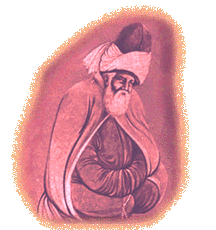
"Don't put in special efforts to witness, just be in a relaxed condition. You are studying your mind movements at mind level.... You are practicing witnessing, you are not being the witness. There is no special effort to be made; it just takes place. About concentration: it is something like running around trying to take a photograph of the government of Bombay. Can you take a photograph of the government?.... Why do you follow these exercises? Give them up. Just be relaxed in your natural state; that is the highest state. The lower state is concentration and meditation."
Nisargadatta Maharaj, Seeds of Consciousness (dialog of Sept. 27. 1979)
*
"The form of meditation that I have found effective differs substantially from that generally given in the manuals on meditation. Repeatedly I have tried stopping of thought and closing out the senses, but the artificial state thus effected was barren of results.... Now, within a process or manifold, a given phase or aspect may be isolated for special attention without stopping the process or eliminating the balance of the manifold. This is a familiar technique in scientific and philosophic thinking. When I recalled this fact and applied it, I found at once a really effective method of meditation....
"I have made many experiments with the meditative and yogic techniques given by the various authorities. In no case have I had any results that were worth the effort so long as I did not supply at least a self-devised modification of my own. Apparently the modification is suggested intuitively. Often I got results by a method diametrically opposite to that suggested by a given authority. At least, so far as my private experience is concerned, the successful method always has to be in some measure an original creation. I suspect the presence of a general principle here, but I am not at present able to deduce a conclusion of universal applicability."
Franklin Merrell-Wolff, Experience and Philosophy ("Concerning Meditative Technique")
*
"Japa [repetition of a sacred word or name of God], becoming mental, becomes contemplation. Dhyana, contemplation and mental japa are the same. When thoughts cease to be promiscuous and one thought persists to the exclusion of all others it is said to be contemplation. The object of japa or dhyana is the exclusion of several thoughts and confining oneself to one single thought. Then that thought too vanishes into its source – absolute consciousness, i.e., the Self. The mind engages in japa and then sinks into its own source....
"Japa helps to fix the mind to a single thought. All other thoughts are first subordinated until they disappear. When it becomes mental it is called dhyana. Dhyana is your true nature. It is however called dhyana because it is made with effort. Effort is necessary so long as thoughts are promiscuous. Because you are with other thoughts, you call the continuity of a single thought meditation or dhyana. If that dhyana becomes effortless it will be found to be your real nature."
Talks with Sri Ramana Maharshi (No. 328)
2012 Experiment
 Ten people signed on for a 6-week project to compare and discuss their
meditation practices, sending in reports once a week for consolidation and
distribution to all participants.
Ten people signed on for a 6-week project to compare and discuss their
meditation practices, sending in reports once a week for consolidation and
distribution to all participants.
Each person's first report included:
- Their goal/objective for the 6 weeks
- Their main complaint
- An overview of their meditation practice prior to this experiment
- Update on their practice, observations, etc., for the preceding week
- Their feelings regarding meditation in the past and future
- Plan for the coming week
The consolidated report also included an essay written by Bob Fergeson for the
participants, titled Movement.
Four of the ten people dropped out before the first report was due. Two of the
remaining six didn't submit the first week's report, due to illness before a
scheduled vipassana retreat for one and vacation for the other. A fifth
person dropped out midway through the experiment due to a large, unplanned
change of life circumstances.
|
"Saving and directing our generated energy can transmute our cleverness into
insight, our sensitivity into self-awareness, our self-indulgence into
strength."
~ Bob Fergeson
|
The participants' second week reports followed this structure:
- An update on their practice, observations, etc., for the week
- Their feelings regarding meditation, looking back and looking forward
- Their feedback and questions for others
- Their plan for the coming week
- Anything else they wanted to communicate
The consolidated report also included a table of objectives and complaints. The
entries from the five people who completed the project were as follows:
Goal/objective:
Keep a consistent meditation practice for the 6-week period, and see the beliefs
that arise in the resistances to keeping this practice.
Main Complaint:
An uncomfortable emotional tension: tension at the jaw and throat, heaviness at
center, and churning at gut. This seems to be my default emotional state, and
has been for a while. I tend to feel pretty tired as a result, and often feel on
the verge of tears.
Goal/objective:
Find out what meditation is, what a good practice would be. In the past I have
meditated off and on, but never realized a stable daily practice for more than a
few months in a row. I feel that having a clear idea of why I meditate will help
in keeping it going.
Main Complaint:
I feel that an end of suffering is possible (or I just don't want to resign to
the inevitability of suffering). There is this continuous whisper in my ear, an
unspoken promise of a life that is better, a way of being that is better. Also I
often felt like a prisoner and somehow wanted to escape. These days I can see
that the prison is my own mind, but how to escape?
Goal/objective:
My main goal for this six week meditation experiment is to solidify a more
specific practice that will help bring about observable results in understanding
myself (small s or big S-self) and its true relationship to the world. I don't
know if this should be separate or not but I'd also prefer/hope that the
meditation might help with my overall anxiety as well which I've struggled with
for many years.
Main Complaint:
My main complaint in relation to my meditation practice is that I'm never sure
if I'm actually making any progress with my meditation. I never feel like I know
if I'm understanding myself better or if I'm just coming up with new
beliefs/ideas about myself and my relationship to the world. Also, my
meditation doesn't seem to be that effective in general.
Goal/objective:
My goal is to try several different methods of meditation and monitor results
for effect. I would intend on then using the top one or two methods for my
regular practice.
Main Complaint:
My main complaint right now as far as meditation goes is that I do not keep a
regular session going daily. I would like to have at least one set time during
the day where I sit for 30 minutes every day, same time. I also do not sit long
enough in my opinion.
Goal/objective:
Use this group as a ways to keep my head on the problem. I am hoping that this
group will affect the way self-inquiry happens during daily life and deepen that
inquiry. I am not going to put any time limits on my meditations, I am going to
return to the "question" as often as I do.
Main Complaint:
Lack of ability in being sincere with myself about what I really want. I guess
this group is also a try at that, trying to be sincere and honest with myself.
I seem to always do things that seem right but not the things that seem right
for me, writing this report and the other one I had to stop a few times to ask
myself "what do I want?" to keep myself on track and not writing things that I
am supposed to.
 For the third week, individual reports covered:
- An update on their practice, observations, etc., for the preceding week
- Response to feedback/questions from others
- Plan for the coming week
The consolidated report also included an essay written for the participants by
Tess Hughes, Meditation.
The fourth and fifth week reports followed the general structure of the two
preceding weeks, alternating between feedback and questions to others followed
by responses as well as updates of each week's meditation experience and plans
for the next week. The forth week content added feedback and questions for
themselves, and the fifth week added responses to the previous week's
self-feedback and questions.
|
"I did two ten day Goenka retreats in the past and both left long lasting
effects on me. I feel sure they contributed to the overall transformation but
without self-inquiry and a correction of my wrong assumptions I could easily
have been stuck there."
~ Tess Hughes
|
The consolidated report for the fifth week included an essay written for the
participants by Shawn Nevins titled Thoughts on Meditation.
The final reports contained:
- An update on their practice, observations, etc., for the preceding week
- Feedback for self and others
- A summation of what they got from the 6-week project vs. their stated
goal/objective
- Plans for moving forward
Summation:
My meditation practice was fairly consistent, missing maybe one session each week, and I feel like this was supported by being in this group. I'm surprised, though, by how I didn't feel more involved or inspired. I've felt like I'm just going through the motions doing this report. I don't feel like I ever really went in depth with what the resistances to practicing meditation are. All I can see is that I feel emotional discomfort, which encourages distraction rather than silence. Like I said in my update this week, I need focusing. A possible line of questioning to move into with this (possibly with the use of the self-feedback sheet I mentioned in my update) is to ask myself what I'm feeling before and after a meditation session, and then maybe to dialogue about this feeling after the meditation. During the meditation, I could procrastinate being caught up in this feeling, since I'd know I would be looking at it at the end of the meditation.
Moving forward:
Create self-feedback sheet for meditation sessions, and begin to use this for each meditation
In periods of silence (which I may need to intentionally create space for), getting a sense for Shawn's description of listening.
Summation:
A renewed focus on meditation and a contemplation of its importance, working and role in the search. I don't find I've come to answers or a clear idea of an approach, so perhaps the time was too short or not auspicious. Meditation is on my radar now though and it feels that in the autumn I will come back to the subject.
Moving forward:
See the previous.
Summation:
I think this 6-week project was definitely effective in helping me sort through the meditation practices I was already familiar with and narrowing down my options to a more specific one that made the most sense. It took almost the entire six weeks to find something that was more suited to me but I'm glad I went through with the project because I feel like I finally settled with one that I can work towards and see observable results (like the strengthening of concentration in my abilities of looking away from thoughts). It was also great to hear how things were going with everyone else, to give and get some feed back and suggestions. My main goal was definitely achieved since I have solidified a more solid routine.
Moving forward:
I plan to try and keep up with my journaling and meditation routine. I'd like to maintain 10 sessions per week, something that I've been struggling with. Hopefully this week will go better. Thanks everyone for all your help and hopefully we can talk again soon and maybe get something else going as well!
Summation:
Jumping right into 30 minutes from an unpredictable practice was too ambitious for me to maintain right off the bat. I will start again with 20 minutes, and if that proves too much I will adjust the length until I am doing it regularly, then slowly increase the time until I reach the 30-minute goal.
I enjoyed this short session and would like to see more of them in the future.
Moving forward:
I have decided on resuming my yoga practice immediately, within it working on pranayama, especially alternate nostril breathing, every day in the morning. In addition I will use deep relaxation just prior to sitting in meditation. Sitting will be for roughly 20 minutes per morning, with the centering prayer of "Let go and let God" bringing me back to center.
Summation:
I am sorry for not being very motivated with this group. I think I have had too much going on with this group and my life in general lately. I am more motivated to continue but I suspect I tend to take too much on my shoulders at once, a pride thing I guess. For this reason I believe this group was not as useful for me as it could have been if I would have been more serious about it.
Moving forward:
I am sorry but I don't feel like I can say much more right now.
I liked the tone of Shawn's essay, his comment on waiting for it to come touched me deeply. His words very much resonated with me.
|
"Embrace the idea that what you see is not what you are. Dwell in the utter
unknowing and hold your mental breath for as long as you can under the still,
clear and deep water."
~ Shawn Nevins
|
Some feedback for the 2012 experiment participants:
Q: Describe your reaction to the statement: "You are absolutely fine just as you are right now."
A: I can't be. I feel too bad to just be ok. I need to do things to fix this bad feeling, this feeling of not ok-ness. I'm not ok because I feel like I'm not ok, and I have to act to fix it.
Q: This sounds pretty heady. Did you try dialoguing with the inner child about his answer?
A: I'm surprised, as I usually am, that this comes across as heady. I guess I'm still discovering how to get out of the way and let my heart speak. I'll take another look at this with dialoguing.
Maybe you're dialoguing with an older child who's a combination of rational and irrational, wanting to fix things himself rather than asking for help. But the frustrated child of any age is asking, innocently or resentfully, for help. I'm thinking about that preschooler who wanted to see the classroom before the first day of school….
Once the knot of non-acceptance is either fixed or sidestepped, what form of help is the inner child, who feels the longing, going to be asking for?
*
 What's important is to question our beliefs rather than to collect data that supports them. Not in a panic mode but by rocking the boat a bit if the sea grows too calm. The boat of beliefs is what keeps us from sinking into our Ocean-ness.
We escape the prison of the mind by seeing and admitting there's no wall of the prison behind us. We can get glimpses of this while still in the mind-boat, still relying on a flotation device of self-belief.
I have a feeling that your recurring anger may be trying to show you something that's blocking your progress. When I read your comment about the group meditation retreat you're currently participating in, "Everybody is present with everybody and giving them a soft, non-judgmental attention. It is letting the light of the other in, instead of the hard focus that we are used to in daily life," I felt that it may reveal something related to your anger. Soft, non-judgmental attention is what we expect from the Perfect Mother or Madonna, the Divine Feminine, and probably from our life-partner. But life is a mixture of feminine and masculine, of soft and hard. We may not want both, but we need both.
When I was taking care of a small herd of goats on the Rose farm, the baby goats each year would take turns getting their heads caught in fencing and then start bleating for help. They only had to turn their heads at the angle their heads had gone through the openings in the first place, but of course they didn't know that. Some of the babies would react calmly when I'd help them get unstuck while others would freak out and fight the help. I remember thinking that each one's reactions were similar to their mother's personality. Anyway, life with all its tensions is trying to help us extricate ourselves from our stuck-ness. And it may be possible to relax into cooperation with it rather than fighting it, accepting and learning both from the hardness and the softness it provides.
*
Glad to hear that you accomplished the goal you set for this project. I find you very open and easy to work with. Some people are harder on others than on themselves (me, for example :-) and some just the reverse. I think you're on the latter end of the teeter-totter when it comes to others. So that's externally, interpersonally. Internally or intrapersonally, I think your identification with negative self-evaluations slows down true self-knowing, which is a process of replacing faulty self-beliefs with less faulty ones. When we judge ourselves based on personal strengths and weaknesses, we're comparing our personal selves (masks) with our judgments of other personal selves … frequently not even objectively. But as Tess realized when she was inquiring about self-worth while looking at some jewelry, our inherent self-worth is based on our shared, common characteristic – gold in the case of her jewelry, being "children of God" in our individual selves. Individually we are all alike in being projections of the One, the All-One, the Alone. As we progressively get to know ourselves, our self-definition shifts from personality (diversity) to individuality (commonality) and, finally, to Oneness (our absolute identity). We shift from lack of trust in our personality, which is good since it's a cacophony of contending fears and desires, to relative trust in our individuality as children of our common Source, to recognition of our absolute nature or Being.
*
I have the impression that you're pulled into confusion by trying to do too many things at once. That can have positive features, but pausing for patience can be a helpful addition. You're the kind of guy who takes his responsibilities seriously, and I can imagine that both your work and home environments provide plenty of stress.
Your decision to take a break from [an ongoing group we're both participating in] is probably a good idea. Hope to hear from you occasionally about how things are going as your life gains or regains some calmness and focus.
*
You have the advantage of being intuitive. If you can harness the power of commitment to go with it, the combination will be powerful enough to move mountains. Commitment keeps some momentum going through periods where inspiration is low, where our attention is distracted by competing demands, through changing conviction states, etc. I'd add to the advice you gave J. of following our heart: don't be afraid of commitment.