Magnetoresistance & the Search for Self
by Art Ticknor
|
The Royal Swedish Academy of Science awarded the Nobel Prize in Physics for 2007 to Albert Fert and Peter Grünberg for their simultaneous and independent discovery of a quantum mechanical effect in the field of magnetoresistance. What caught my attention in the award article I read was the description of magnetoresistance: a phenomenon where the electrical resistance of certain metals decreases by an unusual amount in the presence of a magnetic field. More specifically, it was the connection between a magnetic field and decreased resistance that rang a bell.
The incentive to know the self arises when our "commerce with the world" (to use a phase of Martin Seligman's[1]) isn't going too well. We start off by trying to change others when we aren't getting what we want – and when that fails, we may start to look toward ourself. We may try altering our appearance and, when that doesn't work, we may go after our personality – trying to learn how to project a more attractive or less irritating image in order to satisfy our desires.
Eventually life teaches us, if we're paying attention, that the world cannot provide the satisfaction we seek. In addition to not getting what we want, or to satisfactions not lasting, we are subject to all sorts of vulnerabilities – physical and emotional – including sickness, embarrassment, rejection, failure and, ultimately, death. That realization is bound to bring an experience, or a series of experiences, of hopelessness. If we're fortunate, something awakens our intuition to the recognition that there's a new possibility to explore, and it's within.
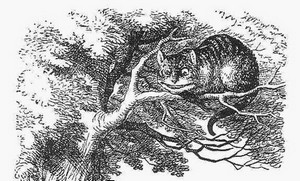
Within is an Alice-in-Wonderland[2] kind of dimension that can only be explored inversely – by backing away from what we experience in order to get a better view. We see that personality, as the word derivation points out, describes the characteristics of a mask and tells us nothing about what's behind the mask. All our beliefs about "I am a person who…." are beliefs about a mask.
When we see past faulty beliefs in personality as what we are, we're still left with a belief in individuality, in being a separate being who's tremendously vulnerable. The journey to knowing the self, which begins with the push of dissatisfaction from not getting what we want, steps up in seriousness with the admission that the individual's vulnerabilities rest on a fear of annihilation. What follows is the universal reaction of trying to find something that will make that vulnerable individual self invulnerable.
|
The problem in the final phase of the search for Self is that the ego-self can't detach itself from itself. The belief in individuality can't unimagine itself. The final transition to knowing the self requires a discontinuity from the type of knowing that we're familiar with – to a knowing by identity, of recognizing our "oneness with." We've unknowingly come closer and closer to the recognition of our true identity as we've seen through the illusion of our faulty self-beliefs and, in the final hour, the magnetic pull at the center of our being overcomes the remaining resistance.
*
Question: What are you? |
 At some point along the way, as more and more of our faulty beliefs about what we are come into view, the motivation for the search changes. We see or feel that the problem is, and has been all along, that there is too much "self" – i.e., those beliefs about what we are. The search becomes what Richard Rose termed an egoless vector. We no longer see anything in it for the belief in individual I-amness, the ego-self,
whose inflation is the problem not the solution. But the momentum that has built up keeps us moving in the direction of finding the answer to the "What am I?" question. Another way to describe this is to say that
the movement now comes from the magnetic pull at the core of our being, which – as the voice of nostalgia has always hinted – is leading us back to our real home.
At some point along the way, as more and more of our faulty beliefs about what we are come into view, the motivation for the search changes. We see or feel that the problem is, and has been all along, that there is too much "self" – i.e., those beliefs about what we are. The search becomes what Richard Rose termed an egoless vector. We no longer see anything in it for the belief in individual I-amness, the ego-self,
whose inflation is the problem not the solution. But the momentum that has built up keeps us moving in the direction of finding the answer to the "What am I?" question. Another way to describe this is to say that
the movement now comes from the magnetic pull at the core of our being, which – as the voice of nostalgia has always hinted – is leading us back to our real home.
|
Footnotes: [1] As quoted by Charles Barber in Comfortably Numb: How Psychiatry is Medicating a Nation :"… Negative emotions contain 'messages about how our commerce with the world is going.'" Seligman is a psych professor at the U. of Pennsylvania. His books include Learned Optimism and Authentic Happiness. [2] See www.ebbemunk.dk/alice/alice1.html
for the complete book of Adventures of Alice in Wonderland.
© 2000-2025. All rights reserved. | Back to Top |