Those curious to learn more about themselves are invited to air their views
and hear what others have to say on the discussion topic in an atmosphere of
friendly investigation. Please read Meeting Guidelines below for a preview of the meeting structure.
Insight Workshops
We meet on occasional weekends, at varying times depending on participants' schedules, to strengthen the bonds of friendship and
stimulate self-inquiry. We employ a variety of techniques including writing, meditation, and questioning each other regarding the
previous Monday discussion and other topics. Other activities include viewing and discussing videotapes and going on outings. A meal
and socializing often precede or follow the informally-structured sessions.
Group Retreats
Existence
2025 November Intensive Retreat
Sunday-Wednesday, November 9th evening to 12th noon.
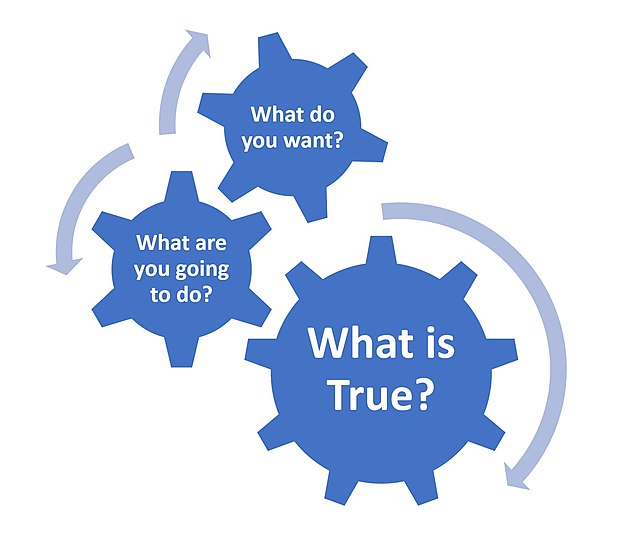
Objective: Solve the existential riddle (and big problem) of life and death. Direction: Inquire into the core of being.
Suppose that:
• What we experience as “our life” is like watching AI machinery at work.
• What we are is providing a stream of data that our AI machinery projects and reacts to.
• The AI machinery is “conscious”:
◦ Knows that it is “here” and
◦ Its attention is hypnotized by what it experiences in time and space.
• The conscious AI machinery can encounter conditions that:
◦ Bring its attention back to its source, before time and space,
◦ Recognizes that absolute Is-ness as its real and true identity, and
◦ Return to its sojourn in time and space.
◦ The sum of which is properly termed as Self-Realization.
“You are aware prior to birth and aware after you die, so you begin with awareness, but you are not conscious of awareness.” ~ Richard Rose (The Direct-Mind Experience)
=> Is Self-Realization—becoming Reality & Truth—serving an ideal that you can see dedicating your life to?
=> If so, how would you or do you go about it?
Location: Claymont Retreat Center, Charles Town, WV
for more information.
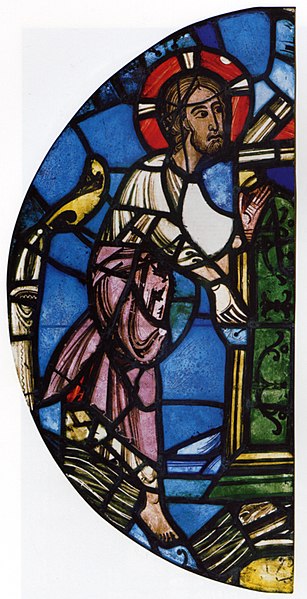
Image from Ascent of Mount Carmel.
Certainty
2024 November Intensive Retreat
Sunday-Wednesday, November 10th evening to 13th noon.
Objective: Solve the existential riddle (and big problem) of life and death. Direction: Inquire into the core of being.
Q: What do you most want to see the last of? (What’s pushing you?)
Q: What is the extreme opposite? (What’s pulling you?)
Q: How will you be sure that what you find will be lasting?
“Truth walks toward us on the path of our questions.” ~ Maisie Dobbs, by Jacqueline Winspear
From “The Ascent of Mount Carmel,” by Juan Ypes (St. John of the Cross)
- To come to the knowledge which you have not
you must go by a way in which you know not.
- To come to the possession you have not
you must go by a way in which you possess not.
- To come to be what you are not
you must go by a way in which you are not.
The path to certainty is a path through uncertainty.
Location: TAT Foundation Center, Hurdle Mills, NC
for more information.
Image from Ascent of Mount Carmel.
Knowing by Identity
2023 November Intensive Retreat
Sunday-Wednesday, November 12th evening to 15th morning.
Objective: Solve the existential riddle (and big problem) of life and death. Direction: Inquire into the core of being.
From Franklin Merrell-Wolff's teaching:
Fundamental in the technique presented by Sri Shankaracharya for the attainment of Realization is the process known as self-analysis. This is a technique in which one convinces himself that his own identity is not with anything whatsoever that is an object of consciousness.
Introception is a third faculty or function of cognition (way of knowing) besides sense perception and conceptual cognition.
Whereas conception establishes the logical relations between concepts, and perception applies concepts to sensations, Introception is Knowledge-through-Identity.
Sitting Down Near
2023 September Intensive Retreat
Friday-Wednesday, September 15th evening to 20th morning.
Objective: Solve the existential riddle (and big problem) of life and death. Direction: Inquire into the core of being.
He moves and He moves not.
He is far, and He is near.
He is within all, and He is outside all.
~ Isha Upanishad
The Sanskrit term Upaniṣad comes from upa "by" and ni-ṣad "sit down," translating to "sitting down near."
If we ask, for instance, whether the position of the electron remains the same, we must say "no"; if we ask whether the position of the electron changes with time, we must say "no"; if we ask whether the electron is at rest, we must say "no"; if we ask whether it is in motion, we must say "no."
~ J. Robert Oppenheimer
You move and you move not.
You are far, and you are near.
You are within all, and you are outside all.
If we ask whether your position remains the same, we must say no; if we ask whether your position changes with time, we must say no; if we ask whether you are at rest, we must say no; if we ask whether you are in motion, we must say no.
Self-Realization
2023 February Intensive Retreat
Friday-Monday, Feb. 10-13
Objective: Solve the existential riddle (and big problem) of life and death. Direction: Inquire into the core of being.
Personality
|| the combination of characteristics or qualities that form an individual's distinctive character
|| the quality or fact of being a person as distinct from a thing or animal (archaic :-)
|| from Latin persona ‘actor's mask, character in a play’ Individuality
|| something that is single; separate
|| from Latin in- ‘not’ + dividuus ‘divisible’
|| thing: an object…. Self-Realization
|| fulfillment of one's own potential
|| liberating knowledge of the true Self
Q: What is your true identity?
Are you identified with what you experience?
Your body?
Your most important physical possessions?
Your thoughts / feelings?
Your decision-making / control?
Is your dissatisfaction related to the quality and evanescence of “positive” experience?
Experience that inflates your self-worth?
Q: Is it important to find/discover/become your true identity?
Is it possible to get behind / anterior to the experience dimension / spacetime?
To our core state of being per Self-Realization testimony?
2022 November Intensive Retreat Finding Our Way Home
Sunday-Friday, Nov. 13–18
Objective: Solve the existential riddle (and big problem) of life and death.
Direction: Inquire into the core of being.
Mode: Individual and group presentations, inquiries, exercises, silence.
"Home is where the heart is." ~ origin sometimes attributed to Pliny the Elder; the first known reference using the exact modern wording appeared in the American novel Scandal by J. T. Bickford (1857).
- Home: the place where one lives permanently; the place from which something originates. ~ Oxford Languages
"I stood in the middle of the world and I appeared to them in the flesh. I found them all drunk. I found none that were thirsty. And my soul was troubled for the children of men, for they are blind in their hearts, and they do not see that they came empty into the world." ~ The Gospel of Thomas; see Douglas Harding’s "A Jesus for Our Time."
- Prodigal: a person who leaves home and behaves recklessly but later makes a repentant return. ~ Oxford Languages
"I maintain that the nostalgic mood becomes the language of the soul It is the inner man trying to get through the earth-man's paradigm, to communicate with him." ~ Richard Rose, The Direct-Mind Experience, "Lecture on Moods"
- Nostalgia: from Greek nostos ‘return home’ + algos ‘pain’. ~ Oxford Languages
Location: The TAT Center in Hurdle Mills, NC
for more information.
2022 June Intensive Retreat The Real Problem
Sunday-Friday, June 5-10
A five-day self-inquiry retreat for those who can arrive by Sunday evening, a four-day or three-day retreat for those who can't make it until Monday or Tuesday.
Objective: Solve the existential riddle (and big problem) of life and death.
Direction: Inquire into the core of being.
The real problem: what am I?
“I am a man is not natural. You are neither this nor that.” Ramana Maharshi.
~ From The Little Book Of Life And Death by Douglas Harding.
In Two Plus Two Equals Reality, William Samuel challenges the reader with fundamental questions:
• Who am I; who are you?
• Why are we here?
• What is the purpose of life?
• Who or what is God?
• What is absolute reality?
Self-Realization answers the classical troika of:
• Who (or what am I)?
• Whence (did I come from before birth)? and
• Whither (am I going after death)?
Location: The TAT Center in Hurdle Mills, NC
for more information.
2022 February Intensive Retreat Longing & Doing
Thursday-Monday, Feb. 17-21
Objective: Solve the existential riddle (and big problem) of life and death.
Direction: Inquire into the core of being.
What we long for is our ideal of perfection.
Do all things for the sake of a higher power, and it will correctly guide your every step.” ~ Richard Rose to Lee W.
Non sibi: not for oneself Determination: (Courage)
CONTINUALLY WORK for ways to accelerate your adventure…. Discrimination:
DO NOT WORK FOR YOURSELF (very important)….
~ From "Decision, Determination and Discrimination”
Location: Horseshoe Lake Park, Ft. McCoy, FL
for more information.
2021 November Intensive Retreat What do you really, really want from life?
Sunday-Friday, Oct. 31 – Nov. 5
>
Objective: Solve the existential riddle (and big problem) of life and death.
Direction: Inquire into the core of being.
Mode: Individual and group presentations, inquiries, exercises, silence.
"When a person really desires something, all the universe conspires to help that person to realize his dream." ~ Paulo Coelho, The Alchemist
"It isn’t normal to know what we want. It is a rare and difficult psychological achievement." ~ Abraham Maslow
"While it's comforting to find evidence that reconfirms one's beliefs, doing so is also dangerous. The researcher is apt to think that he has it all figured out, which is a prelude to stupidity." ~ John Rekenthaler
Location: The TAT Center in Hurdle Mills, NC
for more information.
2021 August Intensive Retreat The Return Home
Sunday-Friday, Aug. 8-13
Objective: Solve the existential riddle (and big problem) of life and death.
Direction: Inquire into the core of being.
Mode: Individual and group presentations, inquiries, exercises, silence.
All day I think about it, then at night I say it. Where did I come from, and what am I supposed to be doing? I have no idea. My soul is from elsewhere, I'm sure of that, And I intend to end up there....
Who says words with my mouth?
Who looks out with my eyes? What is the soul? I cannot stop asking....
I didn't come here of my own accord, and I can't leave that way. Whoever brought me here will have to take me home....
~ Rumi, "The Tavern"
Location: The TAT Center in Hurdle Mills, NC
for more information.
2020 February Intensive Retreat Modern Day Mystics
Friday-Tuesday, Feb. 28 - Mar. 3
Objective: Solve the existential riddle (and big problem) of life and death.
Direction: Inquire into the core of being.
KNOWLEDGE SPEAKS, BUT WISDOM LISTENS. ~ Jimi Hendrix
Mystic: A person who seeks by contemplation and self-surrender to obtain unity with or absorption into the Deity or the absolute, or who believes in the spiritual apprehension of truths that are beyond the intellect. ~ www.lexico.com
Contemplation? Self-surrender? Unity? Absorption? Absolute? Beyond the intellect?
Location: Horseshoe Lake Park, Citra, FL
for more information.
2019 October Intensive Retreat Closing Doors
Sunday-Friday, October 27-November 1
Objective: Solve the existential riddle (and big problem) of life and death.
Direction: Inquire into the core of being.
Whenever you are travelling in what I call the desert without any railroad tracks—you have no trail to go by—you have to have some beacon light, something to guide you. Logic will not do it; your faith alone will not do it; but intuition will. It will take you through the abstract realms.
Any system that pretends to take you into becoming has to have some mechanism for facilitating your skill in becoming—the necessary skill—and that skill involves intuition. You can't argue it out logically, this is the whole thing.
So once you hear it—it amounts to the business of closing doors. The human mind is like this room, and if they're pounding on a piano next door, or the sirens are singing outside that window, you're going to be distracted, and your computer's not going to work—because all this stuff is continually going to be injecting itself into your problem. So the secret of course is closing doors.
Location: Grand Vue Park, Moundsville, WV
for more information.
Image: God Closing the Door of Noah's Ark.
2019 June Intensive Retreat Knowing What You're Not
Monday-Friday, June 10-14
Objective: Solve the existential riddle (and big problem) of life and death.
Direction: Inquire into the core of being.
The seeker is he who is in search of himself.
Give up all questions except one: "Who am I?" After all, the only fact you are sure of is that you are. The "I am" is certain. The "I am this" is not.
Struggle to find out what you are in reality.
To know what you are, you must first investigate and know what you are not.
Discover all that you are not—body, feelings thoughts, time, space, this or that—nothing, concrete or abstract, which you perceive can be you. The very act of perceiving shows that you are not what you perceive.
The clearer you understand on the level of mind you can be described in negative terms only, the quicker will you come to the end of your search….
~ Nisargadatta's recommended path, from the opening page of I Am That.
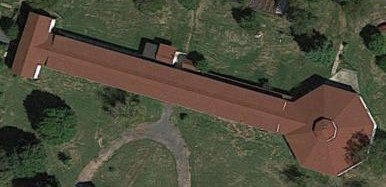
Location: Claymont Great Barn, Charles Town, WV
for more information.
Image: The Claymont Society's Great Barn.
2019 February Intensive Retreat Thought—No-Thought? Do Something—Nothing To Be Done? You Exist—You Don't Exist?
Friday-Monday, Feb. 8-11
Objective: Solve the existential riddle (and big problem) of life and death.
Direction: Inquire into the core of being.
"There is nothing to do, nothing to change. There is no place to get to, no salvation in the future, no final relief or sense of completion in what we call enlightenment. We all are already there. We already have everything we could ever want. The cosmic joke is that who we think we are, our belief in the self, is the only thing that prevents us from experiencing complete fulfillment right now!" ~ Norio Kushi
"Presupposing the existence of a non-existent thing and then wanting to get salvation for that imaginary 'I', you have to start and try to do so through the above-said four paths of yoga.
[1. 'Act without attachment to the fruit thereof', says karma yoga. 2. 'Do not love any other thing; love God alone', says bhakti yoga.
3. 'By separating yourself from God, you have degraded yourself into a petty individual soul (jiva); go and unite with Him again', says raja yoga. 4. 'Know God', says jnana yoga.]
When your sadhanas themselves become a means of giving life to the non-existent ego, how can they destroy it? To do any sadhana except Self-enquiry (atmavichara), the existence of the mind (jiva) is indispensable.
For, how to perform those sadhanas without the mind? To try to destroy the ego by sadhanas other than Self-enquiry is to be just like a thief turning himself into a policeman to catch the thief who is none but himself. Only Self-enquiry can reveal the truth that the ego (mind or jiva) has no existence whatsoever!
"So do not accept this ego, the truth of which you have not yet found out by scrutiny; deny it by giving no importance to its existence, root it out and burn it to extinction by attending to how or from what (whence) it rises!…. Sri Bhagavan used to say that nishkamya karma (desireless action) cannot be done so long as there is a sense of doership while performing the action."
~ Ramana Maharshi
"It seems to me that Joe Bray is an imaginary person, that this show is just happening, that I have no real influence over what turns up next, and that my true nature is just this ‘on-ness', which seems to be there all the time. Whether I am asleep, drunk, happy, sad, seeking or absorbed in some task, ‘on-ness' is just there making it so.
"It is faithfully registering everything that arises, constantly changing in this ceaseless eternal moment. So I am already dead…."
~ Joseph Bray (https://josephbray.wordpress.com/2012/11/11/wasting-my-time/)
Location: Horseshoe Lake Park, Fort McCoy, FL
for more information.
2018 November Intensive Retreat Forgetting & Remembering
Sunday-Friday, November 11-16
Objective: Solve the existential riddle (and big problem) of life and death.
Direction: Inquire into the core of being.
Our birth is but a sleep and a forgetting….
Not in entire forgetfulness….
But trailing clouds of glory do we come
From God, who is our home….
~ William Wordsworth, Ode: Intimations of Immortality
There is one thing in this world which you must never forget to do. If you forget everything else and not this, there is nothing to worry about, but if you remember everything else and forget this, then you
will have done nothing in your life.
~ The Soul of Rumi: A New Collection of Ecstatic Poems
Location: Grand Vue Park, Moundsville, WV
for more information.
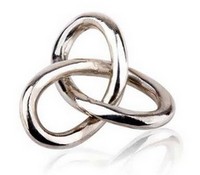
Image: Gordian Knot – symbolic of a problem solved only by bold action.
2018 June Intensive Retreat What Is the Heart of the Spiritual Path?
Sunday-Friday, June 10-15
Objective: Solve the existential riddle (and big problem) of life and death.
Direction: Inquire into the core of being.
That is not what I set out to write today. Instead I wanted to write of the heart of the spiritual path—the quest for our source. Particularly, of the day I realized that the answer to my philosophic questions lay in looking for the source of thought. Prior to that day, I spent nearly two years reading spiritual books, attending Self Knowledge Symposium meetings, challenging and changing my habits and character deficiencies. In short, I was improving my self, becoming a better functioning human being.
~ Shawn Nevins,
Summer, 1992.
Location: Grand Vue Park, Moundsville, WV
for more information.
Image: Winged heart from the Diamond Robe of the Black Madonna (Czestochowa icon) … spiritual analogy of God as a lover wounding his beloved to prepare them for union with him.
2018 March Intensive Retreat Nostalgia – Language of the Soul
Wednesday-Sunday, Mar. 21-25
Objective: Solve the existential riddle (and big problem) of life and death.
Direction: Inquire into the core of being.
Nostalgia is the longing to return Home, to the place of perfection from whence we arose, the kingdom of heaven. How do we go there? What prevents it?
"The desire to trace our way back to the very beginning has led to unprecedented discoveries." ~ Radiolab.org, season 13, episode 7
"Truly I tell you, unless you change and become like little children, you will never enter the kingdom of heaven." ~ Matthew 18:3
Location: Horseshoe Lake Park, Fort McCoy, FL
for more information.
2018 January Intensive Retreat What's My Next Step?
Friday-Sunday, January 26-28
Objective: Solve the existential riddle (and big problem) of life and death.
Direction: Inquire into the core of being.
"Contemporary man … finds it extremely difficult to understand what his beliefs are." ~ Indries Shah, Sufi author and teacher
"People have personalities that result from the drives and demands of the body." "Most of us are helpless to do anything better than we are now doing it." "Nostalgia is subtle and seldom identified by its victims or participants, but I am sure that it is responsible for ninety-five percent of all human behavior. The other five percent is split between reactions to fear and seduction." ~ Richard Rose, "Lecture on Moods," The Direct-Mind Experience
The retreat will focus on beliefs, and on the moods of daytime and dreamtime.
Location: Lynchburg, VA
for more information.
2017 November Intensive Retreat The Treasure Within our Lives Unconnected to Experience
Sunday-Friday, November 12-17
Objective: Solve the existential riddle (and big problem) of life and death.
Direction: Inquire into the core of being.
In his introduction to Chapter 9, "The Pickaxe: Getting to the Treasure Beneath the Foundation," of
The Essential Rumi, Coleman Barks refers to the "treasure within our lives unconnected to experience."
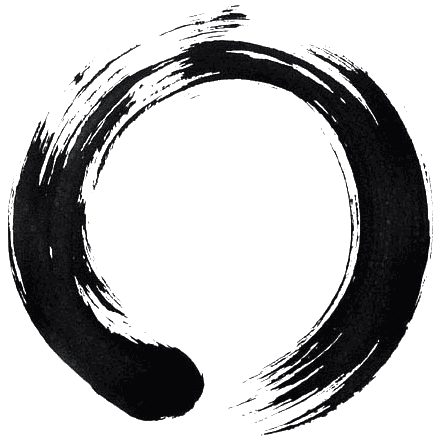
The enso, or calligraphic circle, represents an opening of the mind to That which is beyond experience and beyond imagination.
Location: Grand Vue Park, Moundsville, WV
for more information.
2017 June Intensive Retreat Transcending the Mind
Monday-Friday, June 19-23
Objective: Solve the existential riddle (and big problem) of life and death.
Direction: Inquire into the core of being.
"Our view of identity is that it's a structure made of what we identify with. Rumi says that identity must be torn down, completely demolished along with its little tailoring shop, the patch-sewing of eating and drinking consolation. Inner work is not all ecstatic surrender. Don't listen too often, Rumi advises, to the comforting part of the self that gives you what you want. Pray instead for a tough instructor. Nothing less than the radical disassembling of what we've wanted and gotten, and what we still wish for, allows us to discover the value of true being that lies underneath. The pickaxe, for Rumi, represents whatever does this fierce attention-work: clear discernment, a teacher's presence, simple strength, and honesty with oneself. The pickaxe dismantles the illusory personality and finds two glints in the dirt. Like eyes they are, but these jewels are not personal. Rumi points to a treasure within our lives unconnected to experience. It is intrinsic, beyond calculation, a given, reached after the ego is cleared away and a one-pointedness digs under the premises.
~ "On the Pickaxe" introduction by Coleman Barks to Chapter 9, "The Pickaxe: Getting to the Treasure Beneath the Foundation," of
The Essential Rumi, New Expanded Edition.
Location: Claymont Society, Charles Town, WV
for more information.
2016 November Intensive Retreat A Seeker's Dream
Sunday-Friday, November 13-18
Objective: Solve the existential riddle (and big problem) of life and death.
Direction: Inquire into the core of being.
"A human being is part of the whole, called by us 'Universe,' a part limited in time and space. He experiences himself, his thoughts and feelings as something separated from the rest – a kind of optical delusion of his consciousness. The striving to free oneself from this delusion is the one issue of true religion. Not to nourish the delusion but to try to overcome it is the way to reach the attainable measure of peace of mind." ~ Albert Einstein, 1950 correspondence
Location: Eagle Eyrie, Lynchburg, VA
for more information.
2016 June Intensive Retreat What Shapes Your Future?
Sunday-Friday, June 12-17
Objective: Solve the existential riddle (and big problem) of life and death.
Direction: Inquire into the core of being.
Nothing adds up to something. Something subtracts to Nothing
How does one "go within" to find one's true identity?
We'll have a variety of active sessions and free time to investigate ways and means of self-realization.
Location: Grand Vue Park, Moundsville, WV
for more information.
2016 February Intensive Retreat Looking Back
Friday-Sunday, Feb. 19-21
Objective: Solve the existential riddle (and big problem) of life and death.
Direction: Inquire into the core of being.
"The desire to trace our way back to the very beginning has led to unprecedented discoveries." ~ Radiolab.org, season 13, episode 7
"We're so wrapped up with egotistical things, career, family, having enough money, meeting the mortgage, getting a new car, fixing the radiator when it breaks – we're involved in trillions of little acts just to keep going. So we don't get into the habit of standing back and looking at our lives and saying, Is this all? Is this all I want? Is something missing?" ~ Mitch Albom, Tuesdays with Morrie
"Truly I tell you, unless you change and become like little children, you will never enter the kingdom of heaven." ~ Matthew 18:3
"To enter the Kingdom, you have to become as an autistic little child." ~ Richard Rose
Location: Horseshoe Lake Park, Fort McCoy, FL
for more information.
2015 December Intensive Retreat Deep-Down Scared
Friday-Sunday, Dec. 4-6
Objective: Solve the existential riddle (and big problem) of life and death.
Direction: Inquire into the core of being.
"I am afraid much of the time. Deep-down scared. Afraid so long and continually that it becomes normal and I don't ever realize I'm scared."
Bosnia: "Season by season, the dead sank deeper into the soil – each enduring the severe and exacting labor of leaves and rain and sun in their compression of mineral and stone, there within the worm-driven kingdom of hunger, phyla of the blind."
- Brian Turner, My Life as a Foreign Country - memoir of a young soldier, poet and teacher.
Location: Horseshoe Lake Park, Fort McCoy, FL
for more information.
2015 November Intensive Retreat Discernment
Sunday-Friday, Nov. 15-20
Objective: Solve the existential riddle (and big problem) of life and death.
Direction: Inquire into the core of being.
"If the Truth is within us, and we do not see it, it can only be that we see through the glass darkly, – at this stage of the game." ~ Richard Rose, The Albigen Papers, from chapter 7, "Discernment."
The mind is our tool, our worksite, and our playground in the search for Truth. We capitalize truth to indicate that what we're looking for needs to provide an absolute answer to our core identity in order to be fully satisfying. Of course there's no way to know if that's possible unless we "find it," "go there," or "become it" (highly paradoxical implications).
Location: Grand Vue Park, Moundsville, WV
for more information.
2015 October Men's Intensive Retreat Discernment
Sunday-Friday, Oct. 20-25
Objective: Solve the existential riddle (and big problem) of life and death.
Direction: Inquire into the core of being.
Discernment means separating the wheat from the chaff, the more true from the less true.
In spiritual work, discernment relates to the truth of being: Who or what are we at the core of our beingness? In religious terms we might say that the goal is becoming one with God or All. In psychological terms we might call it self-realization or -recognition.
If discernment is the answer, what's the question?
How to get over yourself!
Location: County Clare, Ireland
for more information.
2015 January Intensive Retreat Reaching the Source of Mind
Friday-Sunday, Jan. 23-25
Objective: Solve the existential riddle (and big problem) of life and death.
Direction: Inquire into the core of being.
The path is not revealed only after explanation and direction; it is inherently always out in the open. Explanation and direction are expedient methods, used to get you to realize enlightenment; they are also temporary byroads. Some attain realization through explanation, some attain realization through direction, some attain by spontaneous awakening; ultimately there is nothing different, no separate attainment. It is simply a matter of reaching the source of mind.
- Foyan (12th century Ch'an master)
Location: Horseshoe Lake Park, Fort McCoy, FL
for more information.
2014 Annual Fall Intensive Retreat "Deeper than Love?"
Sunday-Friday, Nov. 2-7
Objective: Solve the existential riddle (and big problem) of life and death
Direction: Within
Objection: Yes, but ... how do I go, sink or dive within?
There is love, and it is a deep thing
but there are deeper things than love.
First and last, man is alone.
He is born alone, and alone he dies
and alone he is while he lives, in his deepest self.
From "Deeper than Love" by D.H. Lawrence
Let us gather for a few days away from the world, to seek with friends, and to advance towards our true desire.
Location: Grand Vue Park, Moundsville, WV
for more information.
2014 April Intensive Retreat "The One Thing...."
Sunday-Friday, Apr. 6-11
Objective: Solve the existential riddle (and big problem) of life and death.
Direction: Inquire into the core of being.
"The master said there is one thing in this world which must never be forgotten. If you were to forget everything else, there would be no cause for worry, while if you remembered, performed and attended to everything else but forgot that one thing, you would in fact have done nothing whatsoever. It is as if a king had sent you to a country and you perform a hundred tasks, but if you have not performed the task you were sent for, it is as if you have performed nothing at all. So man has come into the world for a particular task, and that is his purpose. If he doesn't perform it, he will have done nothing."
~ Rumi, Table Talk
Location: Grand Vue Park, Moundsville, WV
for more information.
2014 January Intensive Retreat "All Who Live on Earth...."
Friday-Sunday, Jan. 17-19
Objective: Solve the existential riddle (and big problem) of life and death.
Direction: Inquire into the core of being.
All who live on earth are doomed to die.
Is there something to be done?
Die while you're alive
and be absolutely dead.
Then do what ever you want:
it's all good.
- Bunan (1603-1676)
Location: Horseshoe Lake Park, Fort McCoy, FL
for more information.
2013 Annual Fall Intensive Retreat "The Core of Resistance: Yes, but...."
Sunday-Friday, Nov. 3-8
Objective: Solve the existential riddle (and big problem) of life and death
Direction: Within
Objection: Yes, but ... how do I go, sink or dive within?
Cf: The Answer to How is Yes, by Peter Block
There is "yes" and there is "no," then there is "yes, but...." As the Yoda Buddha once said, "Do or do not. There is no try." You've seen it in others when they nod their head in agreement as you speak, but are really just encouraging you to finish so they can raise their objections. You've seen it in your self: that internal resistance that says "not today." You have felt agreement with an idea overpowered by a refusal to act upon it. What is behind this core of resistance?
Let us gather for a few days away from the world, to seek with friends, and to advance towards our true desire.
for more information.
2012 Annual Fall Intensive Retreat "What Is the Real Problem?"
Sunday-Friday, Nov. 4-9
Objective: Find complete & permanent X (Truth, Love, Security, Satisfaction, Reality, Being, etc.)
Direction: Within
Objection: Yes, but ... how do I go, sink or dive within?
The very nature of our inner, personal world is a system of images from our memory arranged according to our individual psychosomatic structures into compensations. By structuring a universe in our mind that is centered on us, these compensations keep us from feeling that we're not the center of the universe.
What do these compensations compensate for? Our illusory belief that we're an individual something separated from Reality, from Truth, from our Source, our Maker. This feeling is captured poignantly in the opening lines of a poem by Richard Rose, "A Worm Beneath a Highway":
I was an earthworm yesterday
And all my life I lived in clay
And did aspire the light....
To understand our compensations, the starting point is to look at our values. There's a table at Benoit Zen recap showing how our values map into 3 pairs of compensations categories, namely:
EGO {BEING ACTED ON BY / ACTING ON} THE OUTSIDE WORLD
EGO {BEING PERCEIVED BY / PERCEIVING} THE OUTSIDE WORLD
EGO AS CREATOR {IN THE OUTSIDE WORLD / WITHIN THE SELF}
"What the compensations compensate is the absence of the eternal Divine Beatitude [beatitude: supreme blessedness or happiness], and nothing can menace that. That is the profound nostalgia of all people.
~ Hubert Benoit, The Supreme Doctrine: Psychological Studies in Zen Thought
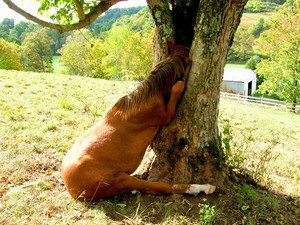
Have you been horsing around with your spiritual development?
We'll be doing something a bit different this summer.
The retreat will be held on a friend's horse farm.
Individual presentations, group discussions, and workshops …
combined with some farm work and time for silent contemplation.
for more information.
2011 Annual Fall Intensive Retreat "Casting off Illusion"
Sunday-Friday, Nov. 13-18
Objective: Find complete & permanent X (Truth, Love, Security, Satisfaction, Reality, Being, etc.)
Direction: Within
Objection: Yes, but ... how do I go, sink or dive within?
The tiger's in a cage...
An opportunity arises, and he jumps
Headlong into freedom,
Only to find himself trapped again
By limitation.
The tiger or the mouse
Discovers there's always been a means of egress
Behind him, back through the projection
Of self and other, into
True Freedom.
for more information.
2011 Annual Summer Men's Intensive Retreat "The Next Step"
Sunday-Friday, Jun. 19-24
"Group Retreat"
Like a bus ride …
Waiting for the bus, it finally appears
We're carried along faster & farther than our own energy would carry us
It offers certain comforts, maybe also some interpersonal frictions
But the ride ends, becomes a memory
It may be the last bus ride …
All experience disappoints, leaves us unfulfilled.
How did life's bus ride get you to where you find yourself?
What is your life-objective?
How would you evaluate your progress-to-date?
What is your next step?
Individual presentations, group discussions, and workshops … combined with plenty of time for silent contemplation and nature walks....
FELT DIMLY in the soul, by world-man unconceived;
Unknown Goal of all yearning;
The Fullness that fills the inner void,
Completing the half-forms of outer life;
The Eternal Beloved, veiled in the objects of human desire;
Undying, Timeless, Everlasting;
Old as Infinity, yet ever new as upspringing youth;
Pearl beyond price, Peace all-enveloping;
Divinity spreading through all.
"Blown-out" in the grand conflagration of Eternity,
Death destroyed as a dream no longer remembered.
Life below but a living death,
Nirvana the ever-living Reality....
~ From Franklin Merrell-Wolff's "Nirvana"
for more information.
Tied Up In Knots?
Once an earnest beginner in the pursuit of Tao came to visit Lao Tzu. As soon
as Lao Tzu saw him, he asked, "Who are all those people whom you have
brought with you?" The disciple whirled around to look. Nothing there.
Panic! Lao Tzu said, "Don't you understand?" This only added
confusion to his panic. Lao Tzu then pressed him to tell him what was ailing
him. The disciple said (to use the version of Thomas Merton):
"When I don't know, people treat me like a fool. When I do know, the
knowledge gets me into trouble. When I fail to do good, I hurt others. When I do
good, I hurt myself. If I avoid my duty, I am remiss, but if I do it I am
ruined. How can I get out of these contradictions? That is what I came to ask
you."
Lao Tzu replied: "A moment ago I looked into your eyes. I saw you were
hemmed in by contradictions. Your words confirm this. You are scared to
death, like a child who has lost father and mother. You are trying to sound
the middle of the ocean with a six-foot pole. You have got lost, and are
trying to find your way back to your own true self. You find nothing but
illegible signposts pointing in all directions. I pity you."
The disciple asked for admittance, took a cell, and there meditated, trying
to cultivate qualities he thought desirable and get rid of others which he
disliked. Ten days of that! Despair!
"Miserable!" said Lao. "All blocked up! Tied in knots! Try to
get untied! If your obstructions are on the outside, do not attempt to grasp
them one by one and thrust them away. Impossible! Learn to ignore them. If
they are within yourself, you cannot destroy them piecemeal, but you can
refuse to let them take effect. If they are both inside and outside, do not
try to hold on to Tao – just hope that Tao will keep hold of you!"
John C.H. Wu,
The Golden Age of Zen
Meeting Guidelines
The meetings serve as forums for discussing issues related to
self-inquiry and self-definition. This is a tricky proposition
– using the mind to understand the mind. To expedite the process, a
facilitator directs the discussion.
Typical meeting formats are round-robin style, where participants have an
equal amount of time to air their views. The object of this airing is to help
each person clarify contradictions, tracing them back to prides and fears
that cloud our mental processes. One of the ways of doing this is a friendly
mode of challenging, or confrontation, not of the person but of his or
her assumptions, beliefs, values and ethics. The facilitator is not to be
confronted, as this disrupts the flow of the meeting.
A successful interchange relies on the cooperation of all participants and
their willingness to "play the game." No one should preach or be
subject to preaching. As much as is humanly possible we should try to:
Listen actively, without interrupting, maintaining a felt connection with
the speaker.
Keep the focus on each participant in turn, avoiding the temptation to
shift the attention to ourselves – either out of a desire to rescue the
person from tension or a desire to be the center of attention ourselves. When
such a shift occurs, the facilitator or other participant should point it
out.
Try to understand the speaker's point of view and challenge him to
question his own thinking, not argue with him or try to sell our views.
 Suppose that:
 Q: What do you most want to see the last of? (What’s pushing you?)
 Objective: Solve the existential riddle (and big problem) of life and death.
 Objective: Solve the existential riddle (and big problem) of life and death.
 If we ask, for instance, whether the position of the electron remains the same, we must say "no"; if we ask whether the position of the electron changes with time, we must say "no"; if we ask whether the electron is at rest, we must say "no"; if we ask whether it is in motion, we must say "no."
~ J. Robert Oppenheimer
If we ask, for instance, whether the position of the electron remains the same, we must say "no"; if we ask whether the position of the electron changes with time, we must say "no"; if we ask whether the electron is at rest, we must say "no"; if we ask whether it is in motion, we must say "no."
~ J. Robert Oppenheimer
 Objective: Solve the existential riddle (and big problem) of life and death.
 Objective: Solve the existential riddle (and big problem) of life and death.
 Objective: Solve the existential riddle (and big problem) of life and death.
 Objective: Solve the existential riddle (and big problem) of life and death.
 Objective: Solve the existential riddle (and big problem) of life and death.
 Objective: Solve the existential riddle (and big problem) of life and death.
 >
Objective: Solve the existential riddle (and big problem) of life and death.
>
Objective: Solve the existential riddle (and big problem) of life and death. Objective: Solve the existential riddle (and big problem) of life and death.
 Objective: Solve the existential riddle (and big problem) of life and death.
 Objective: Solve the existential riddle (and big problem) of life and death.
 Objective: Solve the existential riddle (and big problem) of life and death.
 "Presupposing the existence of a non-existent thing and then wanting to get salvation for that imaginary 'I', you have to start and try to do so through the above-said four paths of yoga.
[1. 'Act without attachment to the fruit thereof', says karma yoga. 2. 'Do not love any other thing; love God alone', says bhakti yoga.
3. 'By separating yourself from God, you have degraded yourself into a petty individual soul (jiva); go and unite with Him again', says raja yoga. 4. 'Know God', says jnana yoga.]
When your sadhanas themselves become a means of giving life to the non-existent ego, how can they destroy it? To do any sadhana except Self-enquiry (atmavichara), the existence of the mind (jiva) is indispensable.
For, how to perform those sadhanas without the mind? To try to destroy the ego by sadhanas other than Self-enquiry is to be just like a thief turning himself into a policeman to catch the thief who is none but himself. Only Self-enquiry can reveal the truth that the ego (mind or jiva) has no existence whatsoever!
"Presupposing the existence of a non-existent thing and then wanting to get salvation for that imaginary 'I', you have to start and try to do so through the above-said four paths of yoga.
[1. 'Act without attachment to the fruit thereof', says karma yoga. 2. 'Do not love any other thing; love God alone', says bhakti yoga.
3. 'By separating yourself from God, you have degraded yourself into a petty individual soul (jiva); go and unite with Him again', says raja yoga. 4. 'Know God', says jnana yoga.]
When your sadhanas themselves become a means of giving life to the non-existent ego, how can they destroy it? To do any sadhana except Self-enquiry (atmavichara), the existence of the mind (jiva) is indispensable.
For, how to perform those sadhanas without the mind? To try to destroy the ego by sadhanas other than Self-enquiry is to be just like a thief turning himself into a policeman to catch the thief who is none but himself. Only Self-enquiry can reveal the truth that the ego (mind or jiva) has no existence whatsoever!
 Objective: Solve the existential riddle (and big problem) of life and death.
 Objective: Solve the existential riddle (and big problem) of life and death.
 Objective: Solve the existential riddle (and big problem) of life and death.
 Objective: Solve the existential riddle (and big problem) of life and death.
 Objective: Solve the existential riddle (and big problem) of life and death.
 Objective: Solve the existential riddle (and big problem) of life and death.
 Objective: Solve the existential riddle (and big problem) of life and death.
 Objective: Solve the existential riddle (and big problem) of life and death.
 "The desire to trace our way back to the very beginning has led to unprecedented discoveries." ~ Radiolab.org, season 13, episode 7
 Objective: Solve the existential riddle (and big problem) of life and death.
 Objective: Solve the existential riddle (and big problem) of life and death.
 Objective: Solve the existential riddle (and big problem) of life and death.
 Objective: Solve the existential riddle (and big problem) of life and death.
 Objective: Solve the existential riddle (and big problem) of life and death
 Objective: Solve the existential riddle (and big problem) of life and death.
 Objective: Solve the existential riddle (and big problem) of life and death.
 Objective: Solve the existential riddle (and big problem) of life and death
 The very nature of our inner, personal world is a system of images from our memory arranged according to our individual psychosomatic structures into compensations. By structuring a universe in our mind that is centered on us, these compensations keep us from feeling that we're not the center of the universe.
 Have you been horsing around with your spiritual development?

 "Group Retreat"

 Meeting Guidelines